JavaScript Substitution
JavaScript substitution allows you to use JavaScript expressions to dynamically generate configuration values. This enables complex logic, calculations, and transformations that go beyond simple variable replacement.
Enabling JavaScript Substitution
To enable JavaScript substitution, use the following configuration:
Or via command line
Syntax
JavaScript substitution uses the following syntax:
- For string substitution:
$(javascript:expression) - For script evaluation:
$${javascript:expression}
The difference is:
- $(javascript:...) always returns a string
- $${javascript:...) can return any JSON type (string, number, boolean, array, object)
Available Context
Environment Variables
Access environment variables using the env object:
{
  "realm": "$${javascript: 'realm-' + (env.APP_ENV || 'default').toLowerCase()}",
  "enabled": "$${javascript: env.APP_ENV !== 'maintenance'}"
}
Date Operations
Use standard JavaScript Date operations:
{
  "timestamp": "$(javascript:new Date().toISOString())",
  "year": "$(javascript:new Date().getFullYear())"
}
System Properties
Access Java system properties:
Performance Considerations
Efficient JavaScript
- Keep expressions simple and fast
- Avoid complex loops in large arrays
- Cache expensive operations
Example: Efficient vs Inefficient
Efficient - simple operations
{
  "realm": "$(javascript:env.REALM_NAME || 'default')",
  "enabled": "$(javascript:env.ENVIRONMENT !== 'test')"
}
Complex - avoid
{
  "users": "$(javascript:" +
    "  // This creates 1000 users and may be slow" +
    "  const users = [];" +
    "  for (let i = 0; i < 1000; i++) {" +
    "    users.push(/* complex user object */);" +
    "  }" +
    "  return users;" +
    ")"
}
Best Practices
- Keep it Simple: Use JavaScript only when necessary
- Provide Defaults: Always have fallback values
- Validate Input: Check and validate environment variables
- Test Thoroughly: Use dry-run mode before production
- Document Logic: Comment complex expressions
- Consider Performance: Avoid expensive operations
- Use Type Coercion: Explicitly convert types when needed
- Handle Errors: Implement proper error handling
- Avoid Side Effects: Keep expressions pure and predictable
- Security First: Never expose sensitive data in expressions
Complete Example
Comprehensive Configuration
Step 1: Create an .env file
Create a file named .env:
export ENVIRONMENT='dev'
export APP_NAME='Acme Portal'
export APP_VERSION='2.3.1'
export COMPANY='Acme Inc'
export APP_URL='http://localhost:3000'
export CLIENT_SECRET='change-me'
export DEFAULT_PASSWORD='password123'
Load it:
Step 2: Create a JSON file with JavaScript substitution
Create realm-js.json:
{
  "realm": "$${javascript: (env.ENVIRONMENT === 'dev') ? 'dev-realm' : (env.ENVIRONMENT === 'staging') ? 'staging-realm' : (env.ENVIRONMENT === 'prod') ? 'prod-realm' : 'default-realm'}",
  "displayName": "$${javascript: (env.APP_NAME || 'My App') + ' - ' + (env.ENVIRONMENT || 'dev') + ' (' + (env.APP_VERSION || '1.0.0') + ')'}",
  "enabled": "$${javascript: env.ENVIRONMENT !== 'maintenance'}",
  "sslRequired": "$${javascript: ['prod', 'production', 'staging'].includes(env.ENVIRONMENT) ? 'all' : 'none'}",
  "registrationAllowed": "$${javascript: env.ENVIRONMENT === 'development'}",
  "attributes": {
    "version": "$${javascript: env.APP_VERSION || '1.0.0'}",
    "deployed_at": "$${javascript: new Date().toISOString()}",
    "company": "$${javascript: env.COMPANY || 'Default Company'}"
  },
  "roles": {
    "realm": [
      {
        "name": "$${javascript: 'role-user-' + (env.ENVIRONMENT || 'dev')}",
        "description": "$${javascript: 'Default user role for ' + (env.ENVIRONMENT || 'dev')}"
      },
      {
        "name": "$${javascript: 'role-admin-' + (env.ENVIRONMENT || 'dev')}",
        "description": "$${javascript: 'Admin role for ' + (env.APP_NAME || 'My App')}"
      }
    ]
  },
  "groups": [
    {
      "name": "$${javascript: 'team-' + (env.ENVIRONMENT || 'dev')}"
    }
  ],
  "users": [
    {
      "username": "$${javascript: 'demo-user-' + (env.ENVIRONMENT || 'dev')}",
      "email": "$${javascript: 'demo-user-' + (env.ENVIRONMENT || 'dev') + '@example.com'}",
      "enabled": true,
      "firstName": "Demo",
      "lastName": "User",
      "realmRoles": ["$${javascript: 'role-user-' + (env.ENVIRONMENT || 'dev')}"],
      "credentials": [
        {
          "type": "password",
          "value": "$${javascript: env.DEFAULT_PASSWORD || 'password123'}",
          "temporary": false
        }
      ]
    },
    {
      "username": "$${javascript: 'demo-admin-' + (env.ENVIRONMENT || 'dev')}",
      "email": "$${javascript: 'demo-admin-' + (env.ENVIRONMENT || 'dev') + '@example.com'}",
      "enabled": true,
      "firstName": "Demo",
      "lastName": "Admin",
      "realmRoles": ["$${javascript: 'role-admin-' + (env.ENVIRONMENT || 'dev')}"],
      "credentials": [
        {
          "type": "password",
          "value": "$${javascript: env.DEFAULT_PASSWORD || 'password123'}",
          "temporary": false
        }
      ]
    }
  ],
  "clients": [
    {
      "clientId": "$${javascript: 'app-' + (env.ENVIRONMENT || 'dev')}",
      "name": "$${javascript: (env.APP_NAME || 'My App') + ' Client'}",
      "description": "$${javascript: 'imported_from=' + (env.USER || 'cli') + '_at_' + new Date().toISOString()}",
      "enabled": true,
      "publicClient": false,
      "standardFlowEnabled": true,
      "directAccessGrantsEnabled": true,
      "secret": "$${javascript: env.CLIENT_SECRET || 'change-me'}",
      "redirectUris": [
        "$${javascript: (env.APP_URL || 'https://example.com') + '/callback'}",
        "$${javascript: (env.APP_URL || 'https://example.com') + '/silent-renew'}"
      ],
      "webOrigins": [
        "$${javascript: env.APP_URL || 'https://example.com'}"
      ]
    }
  ]
}
Step 3: Run keycloak-config-cli (JAR)
Make sure JavaScript evaluation is enabled:
java -jar ./target/keycloak-config-cli.jar \
  --keycloak.url="http://<your-keycloak-url>" \
  --keycloak.user="<your-username>" \
  --keycloak.password="<your-password>" \
  --import.var-substitution.enabled=true \
  --import.var-substitution.script-evaluation-enabled=true \
  --import.files.locations=realm-js.json
Step 4: Verify
You can enter the Realm and confirm the values
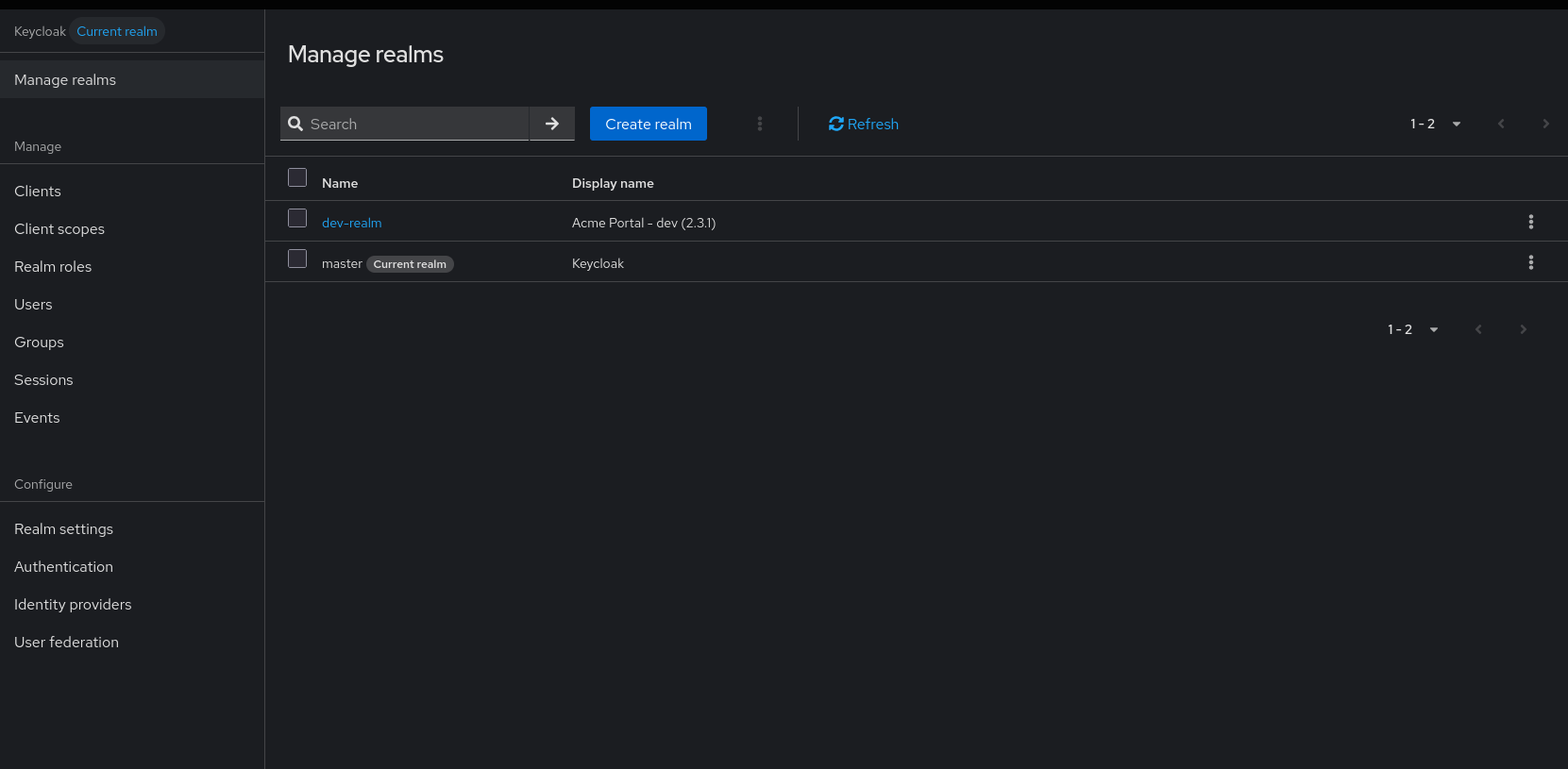
- Realm
dev-realmexists - Display name starts with
Acme Portal - devand ends with the version in parentheses, e.g.(2.3.1) - Realm settings:
- Enabled is
true - SSL required is
none - User registration is
false - Client
app-devexists - Client description starts with
imported_from=and contains a timestamp like2026-04-23T15:59:48.123Z - Redirect URIs contain:
http://localhost:3000/callbackhttp://localhost:3000/silent-renew- Users
demo-user-devanddemo-admin-devexist - Realm attributes include:
environment=devversion=2.3.1company=Acme Inc
Next Steps
- Environment Variables - Environment variable management
- File Operations - File content and properties
- Encoding & Decoding - Base64 and URL operations
- Java Integration - Java constants and version
- Configuration - General configuration options